
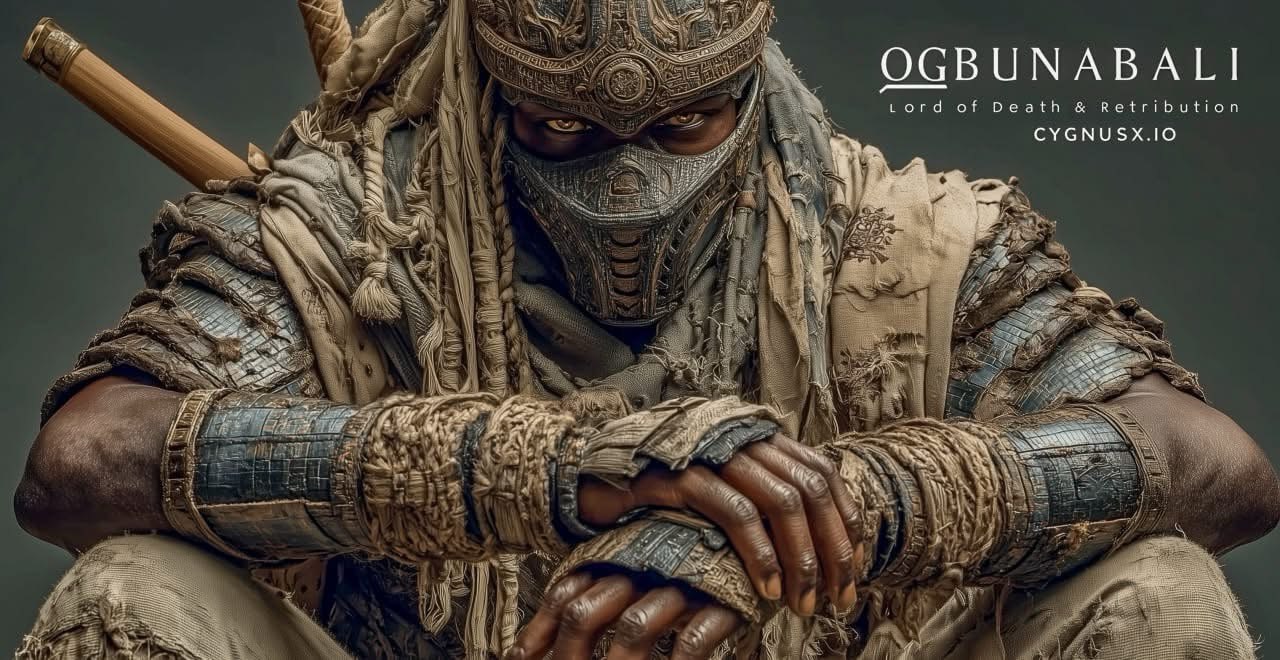
In the Gong Universe
When the night falls silent and the white owl cries, the living remember what the dead have not forgotten.
In the vast darkness between worlds—where the breath of the ancestors meets the silence of the grave—there walks a being whose name alone carries judgment. Ogbunabali, the One Who Kills at Night, is not merely a god of death; he is the shadow of justice itself. In the ancient cosmology of the Igbo people, Ogbunabali was not feared because he brought death—he was revered because he brought balance.
His coming was not chaos. It was order.
In the quiet villages of early Igbo civilization, before the Western notion of law and punishment, morality was not written in books or carved on stone—it lived in spirits. Every act of evil disturbed the moral symmetry of the world, and where imbalance reigned, Ogbunabali moved. He did not judge like men do; he executed the unseen decrees of the ancestors, whose voices echo in the deep.
The elders spoke of the white owl—the silent herald of his passage. When the owl circled above a roof or perched by the threshold, it was said that the spirit world had sent a message. For the pure, it was a warning to correct their path. For the corrupt, it was a summons. The owl saw what humans concealed. And behind its eyes burned the light of Ogbunabali himself.
He is the enforcer of moral symmetry, the unseen hand that strikes when men believe their secrets buried in the dark. At his approach, even shadows hide.
The Dual Nature of Death and Justice
To the uninitiated, Ogbunabali may appear cruel—a killer god, stalking wrongdoers in the still of night. But the wise know his violence was never senseless. His strikes were surgical, his wrath selective. He was the embodiment of cosmic equilibrium—punishing those who defied the moral covenant that bound the living, the dead, and the unborn.
In this, Ogbunabali was not death as an end, but death as correction. A mechanism of purification.
He killed not to destroy, but to restore what had been disturbed.
The Igbo understood this long before the West birthed its courts and prisons. In their cosmology, justice was not man-made—it was woven into existence itself. Ogbunabali’s role in that sacred pattern was akin to a cosmic judiciary, where moral crimes were met not with debate, but consequence.
His existence proved an advanced social construct for its time—a recognition that unchecked evil corrodes society, and that moral accountability must transcend the living. Through Ogbunabali, the Igbo encoded ethical deterrence into their spiritual DNA, centuries before legal philosophy articulated it in words.
The Psychology of Retribution
Psychologically, Ogbunabali was more than a myth—he was a mirror of conscience.
He gave moral form to the invisible fear that curbs evil—the awareness that even when no human witnesses, the cosmos remembers. His presence shaped behavior not through cruelty, but through awareness. He turned morality into a living intelligence.
Even today, his archetype resonates: the dark guardian who enforces unseen order, the avenger who ensures that evil, however veiled, does not go unvisited. He is the shadow every unjust man casts, and the silence that follows every hidden sin.
Allies and Antagonists in the Gong Universe
In the Gong Universe, Ogbunabali stands among other cosmic intelligences who form the moral architecture of existence:
Amadioha, the Thunder God, enforces open judgment by storm and lightning—justice made visible and loud.
Ogbunabali is his silent counterpart, the whisper in the dark to Amadioha’s roar.
Where Amadioha strikes in daylight, Ogbunabali moves unseen, ensuring that justice finds even those who escape the public eye.
Ekwensu, the trickster and messenger, is his unlikely ally. Ekwensu carries word between realms, helping Ogbunabali identify deceit and hidden transgression. Together they form a paradox: chaos and justice, intertwined to preserve balance.
Ala, the Earth Mother, governs morality and taboo (nso Ala). Ogbunabali is her enforcer, her sword. When the living defile the Earth, Ala turns her face away—and Ogbunabali rises in the night.
Yet even he is not without opposition. There are spirits of concealment and corruption—entities who thrive in moral decay, shielding the guilty from cosmic retribution. To them, Ogbunabali is death incarnate, the unstoppable justice they fear.
Ogbunabali in the Diaspora: The Death That Guards the Living
During the Transatlantic Slave Trade, when countless Igbo souls were torn from their homeland, it was said that Ogbunabali crossed the waters with them—not as a curse, but as a guardian.
He haunted the nightmares of the wicked and comforted the enslaved with the promise that injustice never escapes divine notice.
In the diaspora, he became an unseen ally of freedom—a god whose silence meant remembrance. In the Caribbean, Brazil, and the Americas, echoes of his legend merged with local spirits of retribution and protection, evolving into syncretic forms that carried his essence: the night watcher, the silent avenger.
Symbolism and Modern Reflection
In the Gong Universe, Ogbunabali embodies the ancient African realization that order and chaos must dance together. He reminds us that retribution is not always vengeance—it is restoration.
His white owl is the messenger of memory, and his scythe is truth, cutting through deceit and corruption.
To encounter Ogbunabali is not merely to face death, but to face oneself—the part that knows, deep within, that every hidden act is recorded in the fabric of the universe.
“When the white owl lands, the ancestors have spoken.”
Ogbunabali’s myth continues to resonate as a timeless philosophy of justice—a reminder that law, in its truest sense, is not written on paper, but etched in the spirit of the world itself.
He is the death that guards the living.
He is the silence that avenges the wronged.
He is the night that remembers.
He is Ogbunabali.